
The Politics of Nuclear Waste Disposal: Lessons from Australia
In this report, Jim Green and Dimity Hawkins explore Australia’s long and complex engagement with nuclear waste issues.
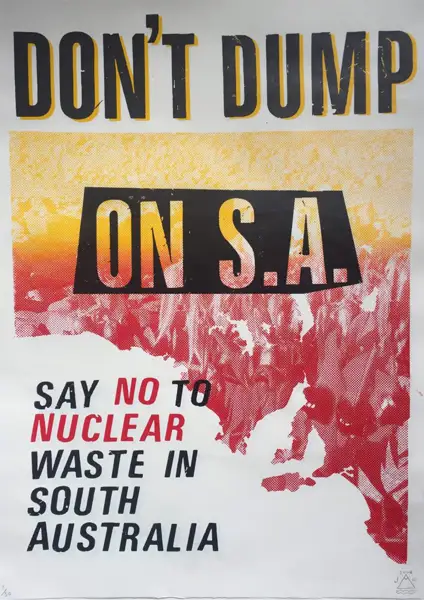
In this report, Jim Green and Dimity Hawkins explore Australia’s long and complex engagement with nuclear waste issues.
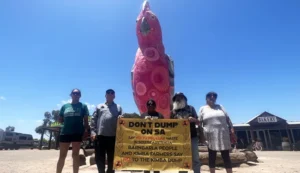
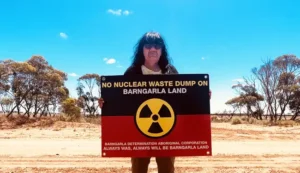
Barngarla people’s position on the National radioactive waste facility.
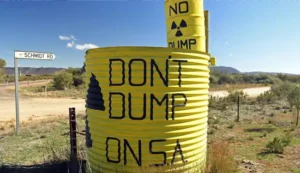
Report prepared by the Conservation Council SA – The Proposed National Radioactive Waste Dump – Implications and Options for SA.
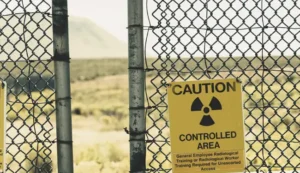
Friends of the Earth fact sheet outlining the gross mismanagement of nuclear waste across Australia and internationally.
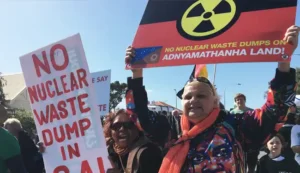
An article written by Adnyamathanha Traditional Owner and academic Jillian Marsh and Jim Green (Friends of the Earth), published in the journal ‘The Extractive Industries and Society’ in 2019.

Paper on nuclear medicine prepared by the Medical Association for the Prevention of War.
The case for an independent inquiry to thoroughly explore radioactive waste management in Australia.
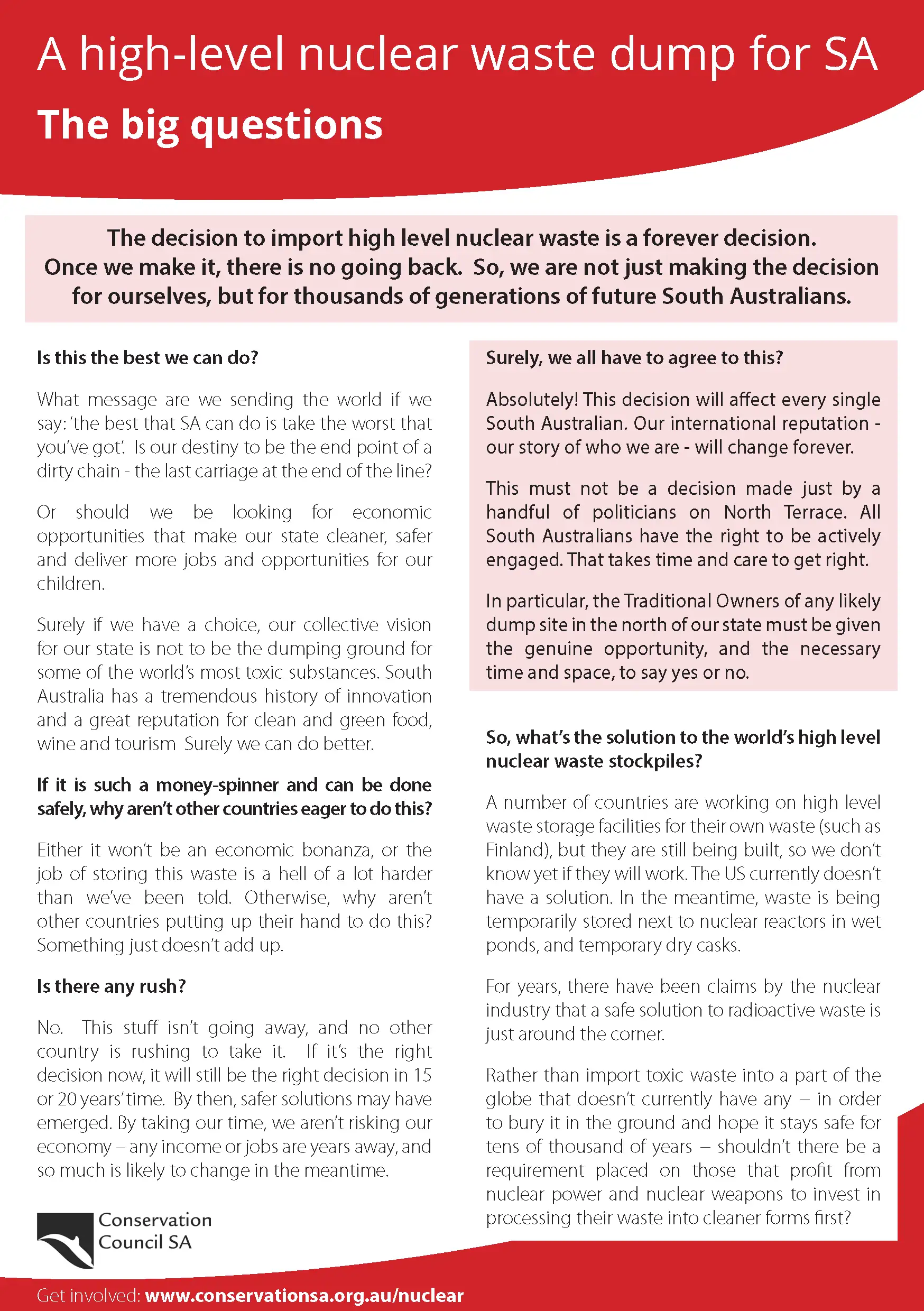
What message are we sending the world if we say: “the best that SA can do is take the worst that you've got”? Is our destiny to be the end point of a dirty chain — the last carriage at the end of the line? Or should we be looking for economic opportunities that make our state cleaner, safer, and deliver more jobs and opportunities for our children?
Surely if we have a choice, our collective vision for our state is not to be the dumping ground for some of the world's most toxic substances. South Australia has a tremendous history of innovation and a great reputation for clean and green food, wine, and tourism. Surely we can do better.
If it is such a money-spinner and can be done safely, why aren't other countries eager to do this? Either it won't be an economic bonanza, or the job of storing this waste is a hell of a lot harder than we've been told. Otherwise, why aren't other countries putting up their hand to do this? Something just doesn't add up.
No. This stuff isn't going away, and no other country is rushing to take it. If it's the right decision now, it will still be the right decision in 15 or 20 years' time. By then, safer solutions may have emerged. By taking our time, we aren't risking our economy — any income or jobs are years away, and so much is likely to change in the meantime.
Absolutely. This decision will affect every single South Australian. Our international reputation — our story of who we are — will change forever. This must not be a decision made just by a handful of politicians on North Terrace. All South Australians have the right to be actively engaged. That takes time and care to get right.
In particular, the Traditional Owners of any likely dump site in the north of our state must be given the genuine opportunity, and the necessary time and space, to say yes or no.
A number of countries are working on high level waste storage facilities for their own waste (such as Finland), but they are still being built, so we don't know yet if they will work. The US currently doesn't have a solution. In the meantime, waste is being temporarily stored next to nuclear reactors in wet ponds, and temporary dry casks.
For years, there have been claims by the nuclear industry that a safe solution to radioactive waste is just around the corner. Rather than import toxic waste into a part of the globe that doesn't currently have any — in order to bury it in the ground and hope it stays safe for tens of thousands of years — shouldn't there be a requirement placed on those that profit from nuclear power and nuclear weapons to invest in processing their waste into cleaner forms first?
The decision to import high level nuclear waste is a forever decision. Once we make it, there is no going back. So, we are not just making the decision for ourselves, but for thousands of generations of future South Australians.
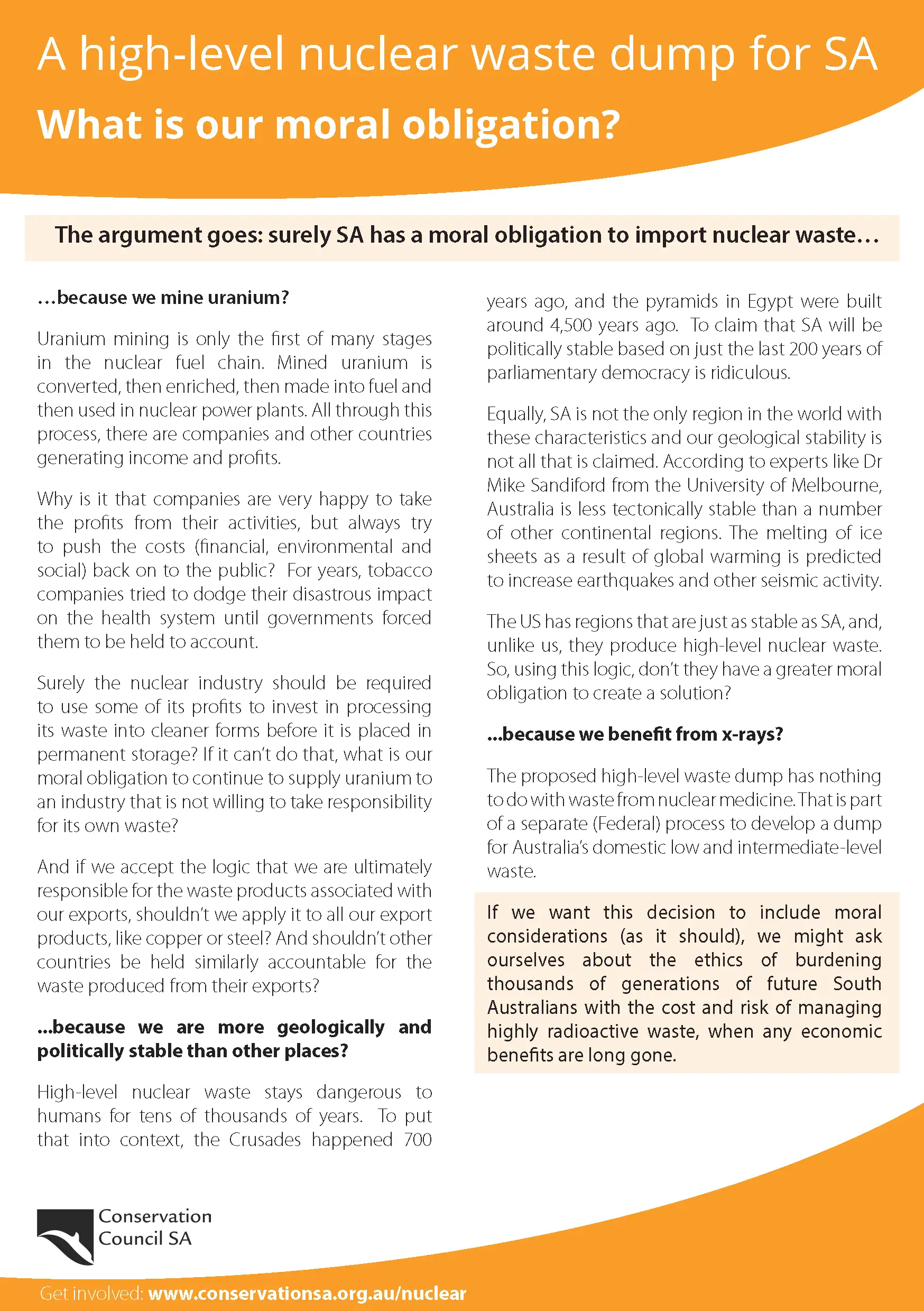
The argument goes: surely SA has a moral obligation to import nuclear waste…
Uranium mining is only the first of many stages in the nuclear fuel chain. Mined uranium is converted, then enriched, then made into fuel and then used in nuclear power plants. All through this process, there are companies and other countries generating income and profits.
Why is it that companies are very happy to take the profits from their activities, but always try to push the costs (financial, environmental and social) back on to the public? For years, tobacco companies tried to dodge their disastrous impact on the health system until governments forced them to be held to account.
Surely the nuclear industry should be required to use some of its profits to invest in processing its waste into cleaner forms before it is placed in permanent storage? If it can’t do that, what is our moral obligation to continue to supply uranium to an industry that is not willing to take responsibility for its own waste?
And if we accept the logic that we are ultimately responsible for the waste products associated with our exports, shouldn’t we apply it to all our export products, like copper or steel? And shouldn’t other countries be held similarly accountable for the waste produced from their exports?
High-level nuclear waste stays dangerous to humans for tens of thousands of years. To put that into context, the Crusades happened 700 years ago, and the pyramids in Egypt were built around 4,500 years ago. To claim that SA will be politically stable based on just the last 200 years of parliamentary democracy is ridiculous.
Equally, SA is not the only region in the world with these characteristics and our geological stability is not all that is claimed. According to experts like Dr Mike Sandiford from the University of Melbourne, Australia is less tectonically stable than a number of other continental regions. The melting of ice sheets as a result of global warming is predicted to increase earthquakes and other seismic activity.
The US has regions that are just as stable as SA and, unlike us, they produce high-level nuclear waste. So, using this logic, don’t they have a greater moral obligation to create a solution?
The proposed high-level waste dump has nothing to do with waste from nuclear medicine. That is part of a separate (Federal) process to develop a dump for Australia’s domestic low and intermediate-level waste.
If we want this decision to include moral considerations (as it should), we might ask ourselves about the ethics of burdening thousands of generations of future South Australians with the cost and risk of managing highly radioactive waste, when any economic benefits are long gone.
Conservation Council SA
Get involved: www.conservationsa.org.au/nuclear
The US spent over $10 billion and invested 20 years planning to store high-level nuclear waste at Yucca Mountain, Nevada, only to abandon the plan due to community opposition.
The Royal Commission often mentions Finland, which is building a waste facility. But the Finnish site is not even complete − it will only start receiving used fuel next decade. And it will only take their own domestic waste. Before we know whether the Finnish technology will even work, the Royal Commission proposes that we in SA import 20 times their planned volume.
The only real-life experience with a deep underground nuclear waste facility anywhere in the world is the intermediate-level Waste Isolation Pilot Plant (WIPP) in the US state of New Mexico. This was supposed to be the most advanced, efficient and safest facility ever developed by any country.
In 2014 there was a fire at the WIPP closely followed by an unrelated rupture of one of the underground barrels, followed by failure of the filtration system designed to keep radiation from the outside environment. Workers were exposed to radiation and the WIPP will now be closed down for at least four years and the repair bill will be over $500 million.
Investigations into these incidents highlight substandard hazard identification and management, and WIPP operators themselves acknowledge that complacency and cost-cutting set in within just 10−15 years of the facility opening.
Even repositories for low and short-lived intermediate-level waste (let alone high-level waste) have run into trouble. Three repositories in the USA have been closed because of environmental problems. Farmers in the Champagne region of France have taken legal action in relation to a leaking radioactive waste dump. In Asse, Germany, all 126,000 barrels of waste already placed in a repository are being removed because of large-scale water infiltration over a period of two decades.
And then there's the issue of safe transport across oceans, through ports and along SA roads for 70 years.
Choosing to import toxic waste is a forever choice. If we can't guarantee we can store it safely for tens of thousands of years we shouldn't take it in the first place.
The honest answer to this question is: we don't know. No-one knows, because in all the years since the Hiroshima bomb, not one country in the world has worked out how to store high level nuclear waste safely for the length of time it remains dangerous to humans.
The Royal Commission recommends we import high level nuclear waste and temporarily place it in above ground storage for at least 17 years while a deep underground repository is built. But what happens if the underground repository doesn't actually work? By then we will already have the toxic waste on our soil and and we can't give it back. What then?
There is no international market for nuclear waste. Therefore, any prices or costs are pure guesswork based on assumptions and modelling.
The Royal Commission's economic modelling contains some extraordinarily optimistic assumptions about future energy costs, profit levels & interest rates.
It assumes that countries with waste stockpiles will pay an inflated price with no real-world justification, and that no other country will choose to compete and offer a cheaper option.
It assumes that Australia, a country with very little nuclear experience, will be able to do something that no other country has ever managed, at a much lower cost than experienced countries estimate.
The modelling doesn't include billions of dollars of extra costs like transport, shipping and insurance… and the list goes on and on...
Perhaps that's why the consultants who did the modelling acknowledge there is a 100% error margin in their calculations. That means that project costs could easily double.
And even if it does make money, any earnings will have to be shared with other states. We will get less GST revenue from the Federal Government.
If more realistic assumptions are made, the bottom line looks very different. Instead of bringing money into our state, it could bankrupt us.
The State Bank collapse cost SA around $3 billion. If this project goes pear-shaped we could lose $128 billion.
At the end of the day, it's simply impossible to weigh up fairly up-front benefits and long term (thousands of years) costs. As prominent SA economist Professor Dick Blandy says:
"The problem with the high level nuclear waste dump is the inescapable risk... of severely adverse outcomes that we might be passing on to tens of thousands of future generations of South Australians... We should think of what we will leave to our descendants – and not do it."
With fears about the economy and future job losses, it's easy to be tempted.
The big question is: if it is such a good deal, then why aren't other countries rushing to do it? Something just doesn't add up.
The reality is there is no massive windfall. In fact, there is a very real chance it will actually end up costing us money. Why?
Possible financial outcomes for SA
Best case (high price, lowest cost): $112B
Most likely (most likely price & cost): -$29B
Worst case (likely price, highest cost): -$128B
yikes!